






You book a manicure with a colour in mind, you leave with a set that looks lovely in the salon mirror, and a few days later something feels off: the nails look short, or they snag on your sleeves, or they simply do not suit your hands the way the photo promised. More often than not, the culprit is not the colour. It is the nail shape.
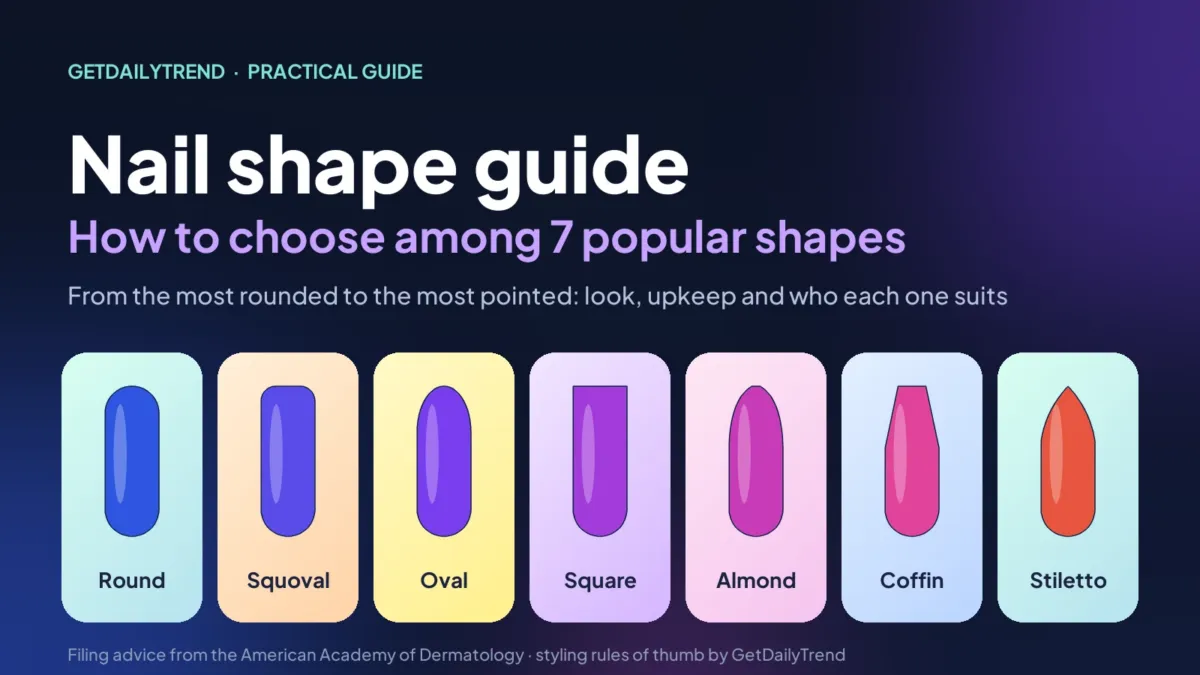
Choosing a nail shape is a practical decision as much as a stylistic one. The outline of the tip changes how long your fingers look, how often the nail catches on things, and how much filing and repair you will need over the next weeks. This guide compares the seven most popular nail shapes, gives you a three-question method to pick one, and explains how to file your nails safely at home.
A word on method. The advice on trimming, filing, cuticles and gel removal comes from the American Academy of Dermatology, and each point is linked to its page. The descriptions of each shape and the “upkeep” ratings are our own summary of rules of thumb that nail technicians commonly share: they are suggestions, not measured results. Please read our disclaimer and our editorial policy for how we work.
Key takeaways
- A nail shape is the outline of the free edge of your nail. Seven are very common: square, squoval, round, oval, almond, coffin and stiletto.
- Three questions help you choose: how wide is your nail bed, how long are your nails, and what does your day involve (typing, cleaning, sport, gardening).
- Rounded and softly squared shapes are the easiest to live with. Long tapered shapes, especially coffin and stiletto, ask for more care and usually need extensions.
- To shape natural nails, dermatologists advise cutting nearly straight across, then filing in one direction and rounding the corners lightly.
- Leave the cuticles alone: cutting or pushing them back can harm the nail.
- Change shape gradually. Going from a square to an almond takes several fillings, not one.
Contents
Why your nail shape matters more than you think
A manicure is seen from a distance of a few centimetres and judged in a second. Within that second, the shape does three jobs at once.
First, it frames the finger. A tip that curves inward at the sides draws the eye along the finger, while a wide flat edge adds visual width. Second, it decides how the nail behaves in daily life: sharp corners catch on fabric, and a long free edge sits more exposed to knocks. Third, it sets the maintenance rhythm, because a shape with a precise outline needs refiling to stay precise.
None of this makes one shape “better”. It means the best nail shape is the one that fits your hands, your nail length and your routine, in that order of importance.
Three questions to choose your nail shape
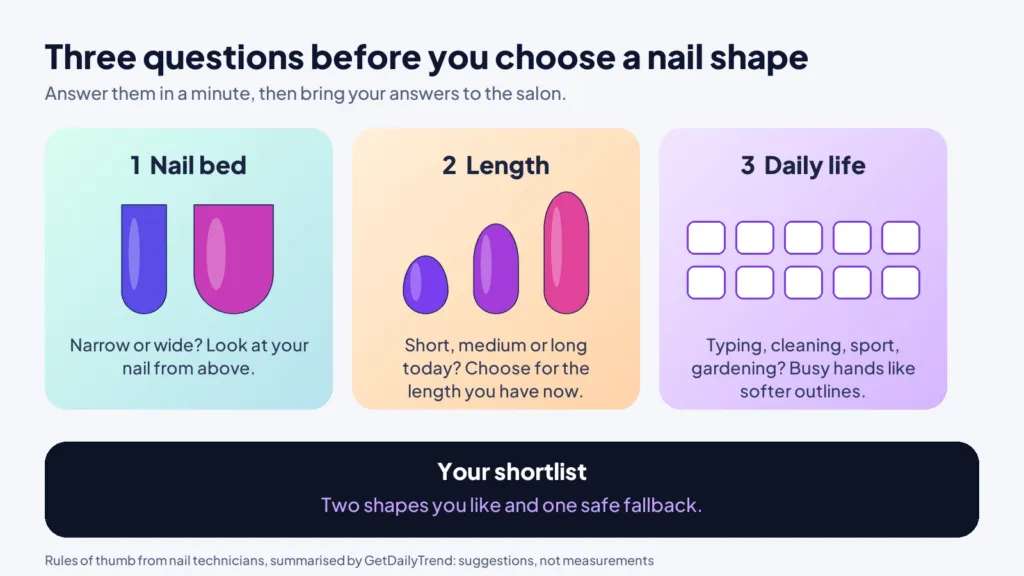
Before you look at inspiration photos, answer three simple questions. They take a minute and save you a disappointing set.
Question 1: how wide is your nail bed, and which nail shape does it suggest?
The nail bed is the pink area under the nail plate, from the cuticle to the point where the nail lifts away. Look at your nail from above: is it long and narrow, or broad and almost square?
A widely repeated rule of thumb among nail technicians says that narrow nail beds look balanced with shapes that add a little width, such as square or squoval, while wider nail beds look softer with shapes that taper slightly, such as oval or almond. Treat it as a starting point, not a law: plenty of people love the “wrong” shape on their hands, and that is a fine reason to choose it.
Question 2: how long are your nails?
Length changes what is realistic. On short natural nails, shapes with a clean curve (round, squoval, oval) are the simplest to keep tidy, and a soft shape can make short nails look neat rather than stubby. Medium and long nails open more options: almond, square and coffin all need some length to read as intended.
If you are growing your nails out, pick the shape for the length you have today, not the one you want in two months. You can move towards the more dramatic outline as the free edge grows.
Question 3: what does your day involve?
Be honest about your routine. If you type for hours, wash dishes by hand, garden, play an instrument or lift weights, a shorter, rounder outline will cause you fewer annoyances. If your hands mostly rest on a desk and you enjoy nail art, you can enjoy a longer and more sculpted shape.
Dermatologists also remind us that rounded corners help: after cutting, they suggest filing the corners lightly so nails are less likely to snag on clothing or furniture.
A quick table to match your answers
| Your situation | Shapes worth trying first | Why |
|---|---|---|
| Short nails, busy hands | Round, squoval | Soft curves, fewer snags |
| Narrow nail bed | Square, squoval | They add a little visual width |
| Wide nail bed | Oval, almond | The tapered tip slims the look |
| Medium to long nails, low upkeep | Oval, squoval | Gentle outline, easy to refile |
| Long nails, nail art | Coffin, square | A flat tip gives room for a design |
| Strong nails and a taste for drama | Almond, stiletto | A pointed tip makes a statement |
The seven most popular nail shapes, one by one
For each shape you will find what it looks like, who tends to enjoy it, what upkeep to expect and what to watch out for.
The square nail shape
A square nail has a straight, flat free edge and sharp corners, which gives a strong, graphic look. It tends to look best on medium lengths, and the flat tip gives nail art a broad canvas.
The catch is the corners. Sharp angles are the first part of the nail to catch on fabric and the first to chip, so square nails ask for regular, careful filing. If you love the look but not the snagging, ask for slightly eased corners: that leads us to the squoval.
The squoval nail shape
“Squoval” is a blend of square and oval: a straight tip with softly rounded corners. Many people find it the most forgiving everyday shape. It keeps the tidy look of a square while removing the sharpest angles, so it is a sensible choice for short and medium nails and for anyone who wants a classic, neat result.
It is also a good stepping stone. If you are curious about a more tapered shape, a squoval is an easy place to start from and to come back to.
The round nail shape
A round nail follows the curve of the fingertip, with no flat section. It is the natural-looking option and one of the easiest to keep, because there are no corners to catch. It suits short nails well, and many people choose it for work that keeps hands busy.
On the downside, a very round tip on a wide nail can look stubby to some eyes. If that bothers you, move one step towards oval by letting the sides taper slightly.
The oval nail shape
An oval nail is longer than it is wide, with a smooth egg-shaped tip and sides that curve in towards the point. It is a classic, feminine outline that elongates the look of the finger and works on a wide range of hands.
Oval is usually considered a moderate upkeep shape: the curve is forgiving, but the tapered sides mean you should avoid letting the nails grow very long if they tend to break.
The almond nail shape
Almond nails taper from the sides to a softly rounded point, like the nut they are named after. The effect is slender and elegant, and it tends to make fingers look longer. It needs a bit of length to read properly, and the narrower tip is more exposed to knocks than a rounded tip.
If your nails are strong, almond is a stylish upgrade. If they are thin or peel easily, consider a shorter almond or a protective finish, and keep an eye on the tip.
The coffin (or ballerina) nail shape
A coffin nail tapers like an almond but ends in a flat, squared-off tip. It is long by definition, which makes it a favourite for bold colours and detailed nail art. It is also a more demanding choice: the narrow, flat tip is exposed, and this length is often achieved with extensions rather than natural nails.
If you love it, plan for regular refills and refiling, and accept that daily tasks will take a little more thought.
The stiletto nail shape
A stiletto is filed to a sharp point, a dramatic outline that suits those who want a high-fashion look. It is the most demanding shape on this list: the long tapered tip breaks more easily and can get in the way of everyday gestures, so it is usually worn on extensions and kept in shape by a technician.
If you are tempted, try an almond first. It gives a taste of the tapered line with a softer tip, and you can always sharpen it later.
Nail shapes compared: look and upkeep at a glance
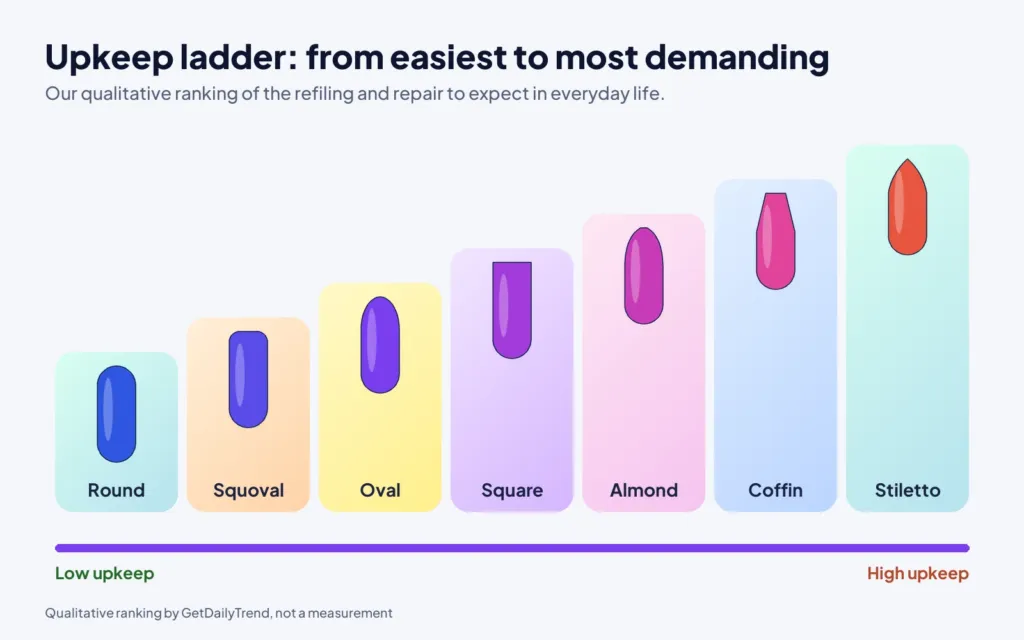
The table below is our own qualitative summary, not a measurement. “Upkeep” means how much refiling and repair we would expect in everyday life, from low to high.
| Shape | Tip | Look | Upkeep | Often chosen for |
|---|---|---|---|---|
| Round | Curved | Natural, soft | Low | Short nails, busy hands |
| Squoval | Flat, eased corners | Neat, classic | Low | Everyday wear |
| Oval | Rounded, tapered sides | Elegant, elongating | Medium | Medium to long nails |
| Square | Flat, sharp corners | Strong, graphic | Medium | Nail art, medium length |
| Almond | Softly pointed | Slender, refined | Medium to high | Longer, strong nails |
| Coffin | Flat, narrow | Bold, dramatic | High | Nail art, extensions |
| Stiletto | Sharp point | Edgy, high fashion | High | Extensions, special looks |
Nail shape and nail bed: how to read your hands
The width of your nail bed is the quickest clue you have. Take a photo of your hands from above, relaxed, with the fingers slightly apart, and compare the width of the nail plate to the width of the fingertip.
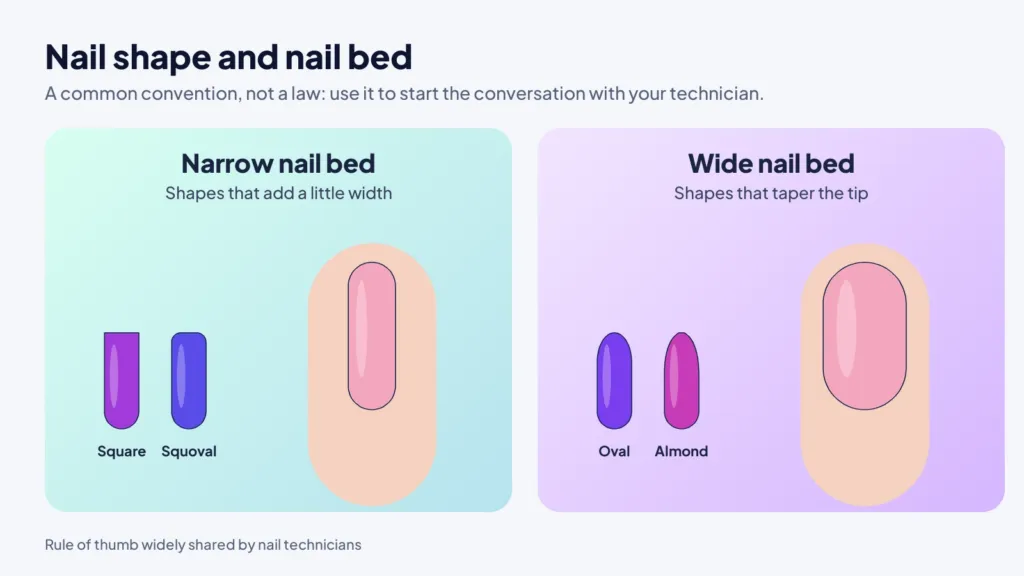
If the nails are narrow compared with the fingertip, a shape that keeps some width at the tip (square, squoval) can make them look fuller. If they are broad, a tapered tip (oval, almond) tends to look lighter. Again, this is a convention, not a rule: use it as a way to start the conversation with your technician, then adjust to what you see in the mirror.
How to shape your nails at home, safely
If you shape your own natural nails, the safest approach is the one dermatologists recommend. The steps below follow the American Academy of Dermatology’s pages on trimming nails and on healthy nail habits.
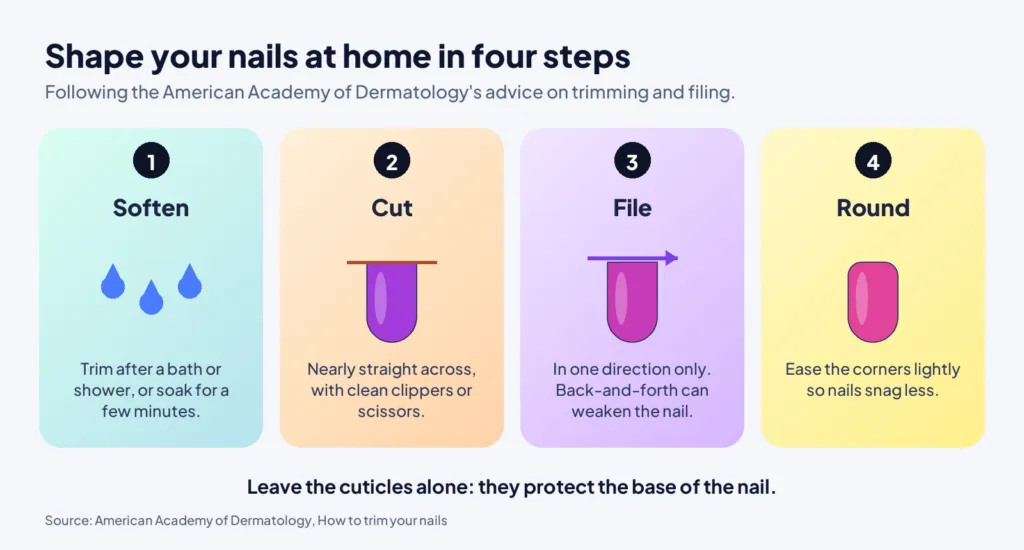
- Soften the nails. Trim right after a bath or shower, when nails are softer, or soak them in lukewarm water for a few minutes first.
- Cut nearly straight across. Use clean clippers or scissors. Disinfecting your tools monthly is also part of the advice.
- File in one direction. Smooth rough edges with a file or an emery board, always stroking the same way. Back-and-forth filing can weaken the nail.
- Round the corners lightly. This reduces snagging on clothing and furniture, and it is the step that turns a square into a squoval.
- Leave the cuticles alone. They protect the base of the nail, and cutting or pushing them back can let bacteria in and lead to infections.
- Moisturise. Rub in a moisturiser after trimming and after washing your hands, and wear gloves for dishes and cleaning, because prolonged contact with water can make nails split or peel.
Natural nails, gel and extensions: what changes for your nail shape
The shapes at the long and pointed end of the list, coffin and stiletto in particular, are usually worn on extensions, since few natural nails stay strong at that length. That is a style choice, but it comes with upkeep: refills, careful removal and a little patience.
If you wear gel polish, the American Academy of Dermatology advises against picking, filing or scraping it off, because this can significantly damage the nail. It describes removal with acetone-soaked cotton wrapped on each nail for about ten minutes, with petroleum jelly on the cuticles and the surrounding skin, and the gentler option of letting the polish grow out. Read the full removal advice before trying it at home.
Remember too that fingernails take about six months to grow out completely, which is a good reason to plan a shape change over several visits instead of expecting everything at once.
How to change your nail shape gradually: from one nail shape to another
Switching from one nail shape to another is easier when you move in steps.
- Square to squoval: ease the corners, keep the length. One visit is enough.
- Squoval to oval: let the sides taper a little more at each filing, over two or three weeks.
- Oval to almond: keep the sides curving inward and narrow the tip gently; this needs some length to look right.
- Almond to coffin or stiletto: only when the nails are strong, and with a technician. Do it in stages so you can step back if it feels like too much.
Going the other way is quicker: it is always easier to file a shape shorter and rounder than to rebuild length.
Common mistakes to avoid when choosing a nail shape
- Copying a photo without checking your hands. Inspiration photos are often taken on long, slim fingers and on extensions. Ask yourself whether the shape fits your nail bed and your length.
- Choosing for length you do not have yet. Pick the nail shape for today’s nails.
- Cutting the cuticles to get a cleaner line. Dermatologists advise against it.
- Filing back and forth. It is faster, but it can weaken the nail.
- Ignoring your daily routine. A shape that snags all day will end up broken by the weekend.
- Forgetting that you can ask. A good technician will talk through the options with you before starting.
A quick checklist before your next manicure
Before you book, run through these points.
- Look at your nail bed from above: narrow, medium or wide?
- Check your current length and how much you are willing to grow.
- Think about your week: typing, cleaning, sport, gardening.
- Choose two nail shapes you like and one safe fallback.
- Bring photos, but also bring your hands: ask for the shape that suits both.
- Plan upkeep: how often can you refile or visit your technician?
Conclusion: choose the nail shape that fits your life
There is no universal best nail shape. Round and squoval are the easiest to wear, oval and almond bring length and elegance, and coffin and stiletto make a statement at the price of more upkeep. Start with your nail bed, your length and your routine, test one change at a time, and treat your cuticles and your natural nails with the care dermatologists recommend.
If you would like to read more about how we work, see our About page, meet our authors or browse more guides in Home & Living.
Frequently asked questions about nail shapes
What is the easiest nail shape to maintain?
Round and squoval are generally the easiest to live with, because they have no sharp corners to catch on fabric. This is a rule of thumb used by nail technicians, not a measured result.
Which nail shape makes fingers look longer?
Oval and almond are the shapes most often suggested, because the tapered sides lead the eye along the finger. A little length helps them read as intended.
Which nail shape is best for short nails?
Round, squoval and oval keep short nails looking neat. Choose the shape for the length you have today and adjust as the free edge grows.
Does my nail bed really decide my nail shape?
It is a useful starting point: narrow nail beds are often paired with shapes that add a little width, and wider ones with tapered tips. It is a convention, not a rule, so choose what you like on your own hands.
How do I file my nails into shape at home?
Dermatologists advise cutting nearly straight across, then filing in one direction with a file or emery board and rounding the corners lightly. Back-and-forth filing can weaken the nail.
Should I cut my cuticles to get a cleaner shape?
No. The American Academy of Dermatology advises leaving cuticles alone, because they protect the base of the nail and cutting or pushing them back can lead to infection.
Are coffin and stiletto nails bad for my natural nails?
They are not a health recommendation either way, but their length and tapered tip make them more fragile, so they are usually worn on extensions. If your nails change, swell or hurt, see a dermatologist.
How long does it take to change my nail shape?
Fingernails take about six months to grow out completely, so a big change is best done in stages over several visits, for example square to squoval, then squoval to oval.